How a dry stone wall drains
No cement, no weep holes, and still standing after a hundred winters. The way the old terraces were built, and why we build them the same way.
- Written by
- Joan Ribera
- Topic
- Building
- Reading
- 1 min
The terraces on the hills behind Oliva and Dénia were built without a bag of cement between them. Many are older than the houses they hold up. When they fail, it is almost always because someone repaired them with mortar.
Water is the problem
A retaining wall holds back soil, and soil holds water. After a storm, a slope can push against a wall with several times its dry weight. A cement wall traps that water until it either cracks or tips.
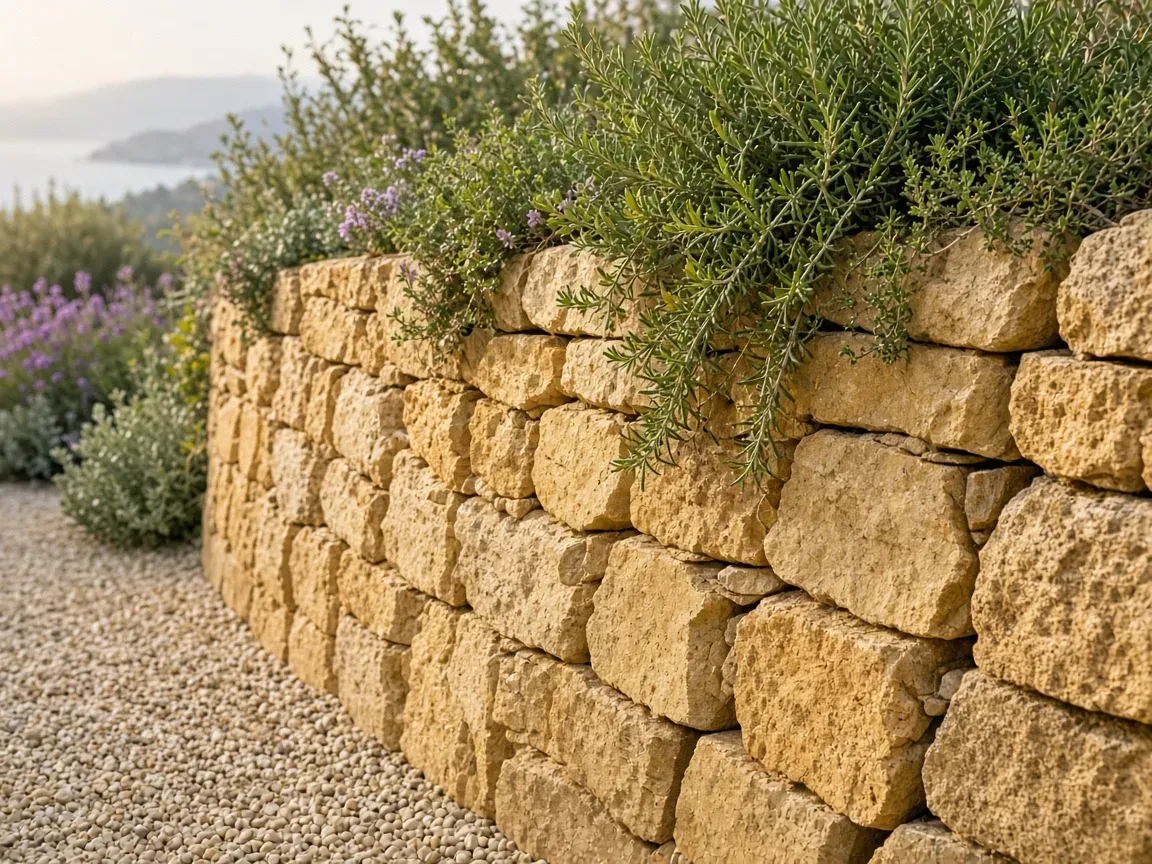
A dry stone wall lets it through. Every joint is a drain, so the pressure never builds.
How we build one
The base is dug into firm ground and laid with the largest stones, set lengthways into the slope. The wall leans back into the hill, about 10 cm for every metre of height.
Behind the face goes a layer of small broken stone, the hearting, which carries water down and out. Every metre or so, a long through stone ties the face back into the slope.
The top is finished with heavy flat stones, or left as a planting edge for rosemary and thyme.
Where the stone comes from
As often as possible, from the site. Old walls are taken down by hand, the stones sorted by size and laid again. When we need more, we buy from a quarry in Benissa that matches the local limestone.
A good waller lays about a square metre a day. It is slow, and it lasts a century.